Review: Pirate Crossfire

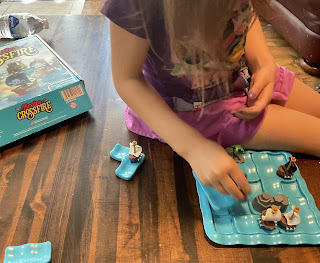
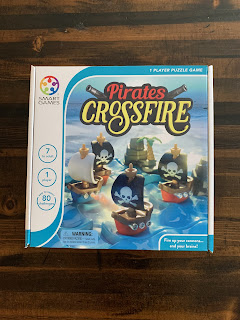
In our ongoing obsession with Smart Games, we’ve recently added Pirate Crossfire to our tabletop fleet. Designed for the solo strategist aged seven and up, this game is an exercise in tactical positioning and logic. It features four distinct modes, each tiered with four levels of difficulty. One of the more elegant design choices is that the foundational rules remain consistent across all modes, whether you are playing "Peace" (where no ships are under fire), "Pirates Win," "Navy Wins," or the chaotic "Everyone Loses" scenario. The mission is deceptively simple: you lock the immovable rock pieces into place as dictated by the challenge, and then must orient your ships so their cannons—which fire only from the sides—align with the target (or avoid it entirely) based on the chosen mode.
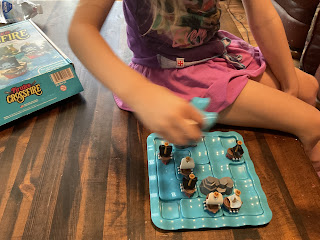
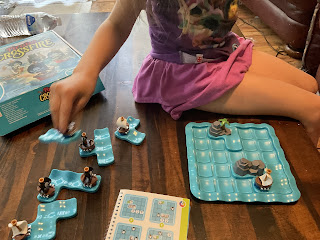
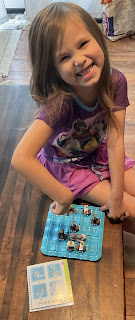
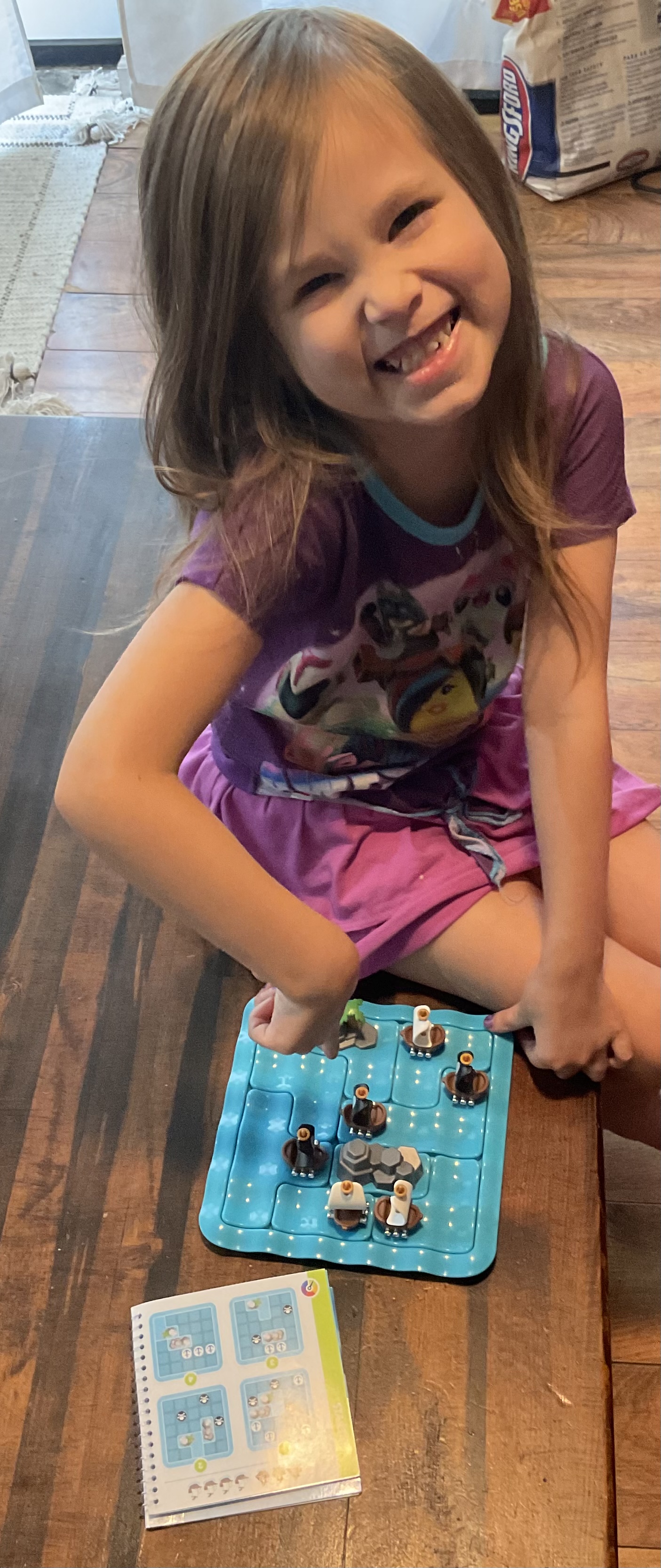
I am a fervent supporter of the "single solution" philosophy in logic games; it provides a definitive sense of accomplishment once the puzzle is solved. However, I must offer a candid warning: Pirate Crossfire is genuinely rigorous. Even I found the advanced challenges to be quite the intellectual workout! Because the difficulty curve is steep, I’ve developed a scaffolding technique for my daughter: I allow her to choose one ship for me to place in the correct orientation. If she remains adrift, I’ll place a second. Usually, those two hints provide just enough wind in her sails to navigate the rest of the challenge on her own. This game is a powerhouse for developing spatial awareness, directional logic, and fine motor skills.


The manufacturing quality is quintessential Smart Games. The pieces possess a satisfying heft and a level of durability that is vital for a family like ours—where my daughters and I share a certain "clumsy" charm. You won't have to worry about a stray drop resulting in a broken mast. While the game is a magnificent "quiet time" resource that allows me to conquer a mountain of housework while my daughter learns, its physical footprint is a bit too substantial for a "doctor’s office" travel game. It is best reserved for a dedicated desk or the dining room table.


If you are looking to elevate your child’s critical thinking through play, Pirate Crossfire is a premier choice. It successfully balances the frustration of a complex puzzle with the immense satisfaction of a solved "battle." I am curious to hear from my fellow logic-lovers: which Smart Games titles have become staples in your household, and do you have a favorite "travel-sized" alternative for those on-the-go moments? Let us know in the comments below!

Comments

  1. I love thinking games, and this one looks like lots of fun. I'll have to try it out!

    ReplyDelete

Post a Comment

Popular posts from this blog

Review: All About Reading Level 4

We have officially reached the summit of  All About Reading Level 4 , and I am currently accepting trophies, high-fives, and perhaps a very large latte. If you had told me a few years ago that we’d be tackling "anomalous phonetic structures" and "loanwords" without a total household meltdown, I would have assumed you were hallucinating. Yet, here we are, and I am officially a fan-girl for All About Learning Press. This final level is essentially the "Black Belt" of literacy instruction, diving into the deep end of the linguistic pool with a level of clarity that is frankly miraculous. The curriculum tackles those treacherous "borrowed" words that usually make the English language look like it was put together in a blender. As a dyslexic educator teaching a fellow dyslexic, I’ll be entirely transparent: I encountered phonetic principles in these four levels that were completely absent from my own public school experience. I was basically learning ...

Review: Djeco Pompom Pictures - All Aboard

Djeco Pompom  is a super cute and easy art craft for toddlers. They just put the pompoms on the corresponding dots. I like that it comes with all the pompoms you need. However, the glue stick they give you doesn’t make the pompoms sticks to the board. I tried regular glue and that didn’t work either so I ended up having to use a hot glue gun. So, I suggest having hot glue if you get this. There are small circles on the boards to let you know what color pompom goes where so it’s pretty self-explanatory. The kit does come with a small manual that it done with pictures so even your little one can look at the manual and understand which pompoms go on which board. 

Review: A to Z Board Book

In our household, literature is the cornerstone of early education, so we began our daily reading rituals when our daughters were mere infants. While our shelves are currently burgeoning with an eclectic array of alphabet primers, the  A to Z Board Book  has secured a particularly prestigious position in our rotation. As the name suggests, this is a board book—a vital feature for anyone navigating the "destructive" phase of toddlerhood. My youngest has a penchant for paper shredding that would rival a high-end office machine, so the sturdy construction of a board book is a non-negotiable necessity. However, because this is a "lift-the-flap" volume, I maintain a strict "supervised access only" policy to ensure the flaps remain attached to their respective pages. We have integrated this book into our daily school routine, as it offers a multifaceted sensory experience. My daughter is currently enchanted by the interactive elements, relishing the opportunity ...