
It appears we have stumbled upon the Great Homeschooling Divide: the polarizing world of standardized testing. While many of my fellow educators in the Republic of Texas enjoy our state’s blissful lack of mandatory assessments, I have opted for a more proactive—albeit slightly clandestine—approach. I incorporate tests, quizzes, and reviews into our schedule with all the subtlety of a secret agent. My daughter remains blissfully unaware that she is being formally evaluated, mostly because I refuse to treat these sessions like a high-stakes interrogation. I might occasionally mutter about a "review week" while hovering over my planner, but since I maintain my composure, she views it as just another Tuesday rather than a daunting academic hurdle.
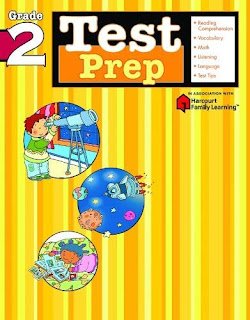


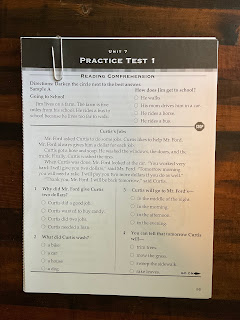

Last year, we introduced Test Prep into our repertoire, and I must admit, I am quite enamored with its efficiency. It elegantly synthesizes the two pillars of primary education: English and Mathematics. The literacy portion is surprisingly comprehensive, encompassing everything from reading comprehension and vocabulary to the more nuanced mechanics of writing and grammar. It isn't merely a series of dry questions; it requires the student to demonstrate genuine proficiency in identifying main ideas, understanding cause-and-effect relationships, and navigating the treacherous waters of suffixes and word meanings.

The mathematics component is equally well-structured, split into two distinct and purposeful sections. The first is a brief, tactical exercise in problem-solving logic, forcing the student to filter out irrelevant information and focus solely on the pertinent data—a skill many adults, including myself on a bad day, have yet to master. The second section involves actual computation, which I found to be quite foundational for the second-grade level. Since we utilize the rigorous Math-U-See curriculum, my daughter often finds these problems significantly less taxing than her daily coursework, which certainly helps maintain her academic confidence.

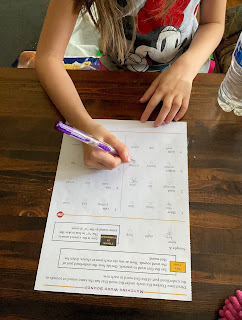
What I find most appealing about this workbook is its utility as a diagnostic benchmark to see where she falls according to standardized norms. We initiate this process mid-year, tackling a single page at a time to maintain a low-pressure environment. The book is cleverly designed with "stop" prompts at the bottom of certain pages, which serves as a natural boundary for our sessions. Because the layout is vibrant and the questions are not densely packed, my daughter treats it as just another colorful activity in her folder. She hasn't realized yet that she’s being "tested," and I am perfectly content to keep that secret under lock and key.

While I wouldn't label this a mandatory "must-have" for every family, it is a sophisticated tool for any parent who desires a data-driven snapshot of their child’s progress. The practice tests at the conclusion of the booklet are excellent for building "test-taking stamina" without the typical accompanying anxiety. We initially received this via our 2nd Grade Timberdoodle kit, and I found it useful enough to ensure its inclusion in our third-grade curriculum as well. I am curious to hear from the rest of the community: do you embrace the test, or do you flee from it? Let us know your preferred methods of assessment in the comments below!

Comments
Post a Comment